Creation and Destruction
Bridging the gap between Modern Economics theory and Ancient Indian Wisdom Traditions
By Nandini Bhautoo
In a news report on First Post, journalist Palki Sharma makes an intriguing connection between recent Nobel Prize-winning work on economic creation and destruction, and ideas found in ancient Hindu philosophy. The linking paradigm is creative destruction — the concept that new systems arise from the breakdown of old ones. In Hindu thought, this is beautifully represented by the dance of Shiva, where destruction is not an end, but a prelude to renewal. The world-famous statue of Nataraja that stands at the entrance of the CERN complex in Geneva is a symbolic acknowledgment of this timeless truth by one of the world’s leading scientific institutions.
As our scientific understanding deepens, humanity is beginning to realize that many discoveries we now describe with complex equations and experiments were already expressed in myth, metaphor, and spiritual symbolism thousands of years ago. What the Western rational mind once dismissed as poetic imagination is increasingly being recognized as intuitive knowledge encoded in culture.
 “The ancient image of Indra’s Net, drawn from Hindu and Buddhist cosmologies, describes a universe made of infinite reflections — where every point contains and mirrors the whole. This idea resembles modern concepts in fractal geometry and network theory, where each part of a system reflects its total structure. It’s a remarkably sophisticated way of imagining a complex, interconnected universe…”
For example, the ancient image of Indra’s Net, drawn from Hindu and Buddhist cosmologies, describes a universe made of infinite reflections — where every point contains and mirrors the whole. This idea resembles modern concepts in fractal geometry and network theory, where each part of a system reflects its total structure. It’s a remarkably sophisticated way of imagining a complex, interconnected universe.
Another example comes from the quantum world. Experiments such as the double-slit experiment suggest that consciousness is not a passive observer but an active participant in reality. This echoes what mystics and philosophers have said for centuries: that our awareness shapes the world around us. This insight isn’t far removed from Plato’s famous Allegory of the Cave, which reminds us that what we perceive is only a shadow of a deeper truth.
Even the stories of Krishna Leela, sometimes dismissed as religious myth or interpreted only in devotional terms, carry a scientific resonance when read symbolically. The idea that reality itself is a cosmic play, constantly unfolding and reshaping itself, aligns closely with the modern quantum model of the universe — a reality that is dynamic and participatory, not fixed and mechanical.
This is also where the concept of Kundalini offers an interesting parallel. In yogic philosophy, Kundalini represents a subtle energy believed to lie dormant at the base of the spine, waiting to rise through the body’s energy centres to awaken higher consciousness. While spiritual in origin, this idea finds echoes in modern understandings of the nervous system, energy flow, and even brain plasticity. More broadly, it reflects a universal human intuition: that transformation begins within, through the awakening of deeper layers of awareness.
Similarly, the idea of Brahman — the formless, underlying reality of everything — can be loosely compared to the scientific quest to understand the unified field that connects all forces and particles in the universe. Scientists use mathematics to describe the knowledge that spiritual traditions have expressed and preserved through metaphor: that there is a single underlying fabric behind all apparent diversity.
Modern economics and ancient philosophy may seem to belong to completely different worlds, but both grapple with cycles of creation, collapse, and renewal. Carl Jung introduced the idea of archetypes — universal patterns that shape human experience. Creative destruction may well be such an archetype, expressing itself in myths, economies, and civilisations alike.
Today, the world seems to be going through a moment of profound upheaval. Political systems, cultural norms, and economic structures are being tested as never before. But viewed from a wider perspective, this may not be an ending — it may be a transition. Old paradigms fall so that new ones can emerge. This is the rhythm of history, of nature, and perhaps of the universe itself.
When faced with uncertainty, humanity has two choices: cling to what is fading or embrace the unknown with the understanding that transformation is part of a larger pattern. To stall is to regress. To step forward, even without certainty, is to participate consciously in the unfolding of a new chapter.
Mauritius Times ePaper Friday 17 October 2025
An Appeal
Dear Reader
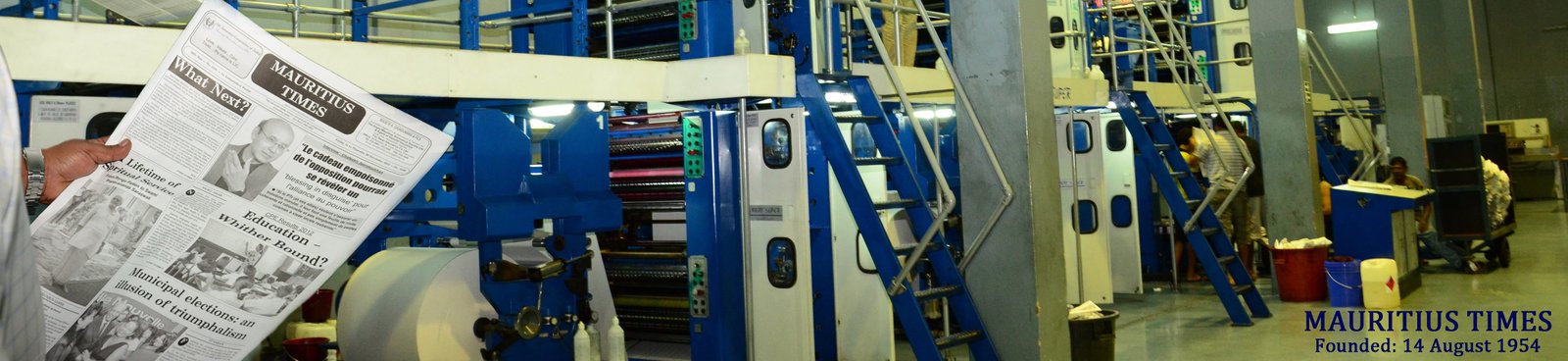
65 years ago Mauritius Times was founded with a resolve to fight for justice and fairness and the advancement of the public good. It has never deviated from this principle no matter how daunting the challenges and how costly the price it has had to pay at different times of our history.
With print journalism struggling to keep afloat due to falling advertising revenues and the wide availability of free sources of information, it is crucially important for the Mauritius Times to survive and prosper. We can only continue doing it with the support of our readers.
The best way you can support our efforts is to take a subscription or by making a recurring donation through a Standing Order to our non-profit Foundation.
Thank you.


