India’s Transformation and Its Independent Voice
Carnet Hebdo
By Nita Chicooree-Mercier
Post-2014 India instilled an unparalleled commitment to the upliftment of the country’s 1.4 billion people in the hearts and minds of the new government team, backed by a strong spirit of patriotism. The face of India underwent a tremendous and spectacular transformation, resulting from a long-awaited dynamism, and henceforth began looking towards the future with self-confidence and optimism. The Delhi central government set itself the task of initiating grand operations to galvanise citizens and take them on board to participate collectively in the development of their country.

Spectacular national initiatives marked the first years of the ruling party, the Bharatiya Janata Party (the People’s Party of India). To name a few, the Swachh Bharat Abhiyan promoted cleanliness in public areas, alongside the financing of millions of toilets and the creation of millions of bank accounts to connect the masses to the modern financial system, enabling them to access financial aid directly and thus liberating them from the feudal system of unscrupulous landlords. Electricity networks reached thousands of rural regions that had been deprived of them for decades. To top it all, the Unified Payments Interface (UPI), a digital payment system, drastically changed the way money circulated, from hand-to-hand transactions to mobile phones. What a former Congress finance minister thought was impossible on account of widespread illiteracy was made possible. ‘Modi hai to mumkin hai’ became the new slogan.
Modern public infrastructure was, and continues to be, developed at an unrelenting pace. Highways, bridges, high-speed trains and new airport buildings sprang up in many regions. The ‘Make in India’ policy, formulated in response to the domestic market for Western fighter jets and trade deals, has been implemented with conditions on the transfer of technology. Geopolitical tensions, warring factions and volatile partnerships have urged India to reinforce its self-reliance through locally made weapons, tanks, missiles and naval assets, thus strengthening its defence system in a way never seen before. India’s Operation Sindoor, in retaliation for a Pakistan-backed terrorist attack on Indian citizens in Kashmir in 2025, showed the efficiency of BrahMos missiles in strikes on the Kirana Hills in Pakistan.
Successive governments’ policies on trade deals with Western nations echo the stance taken by Shri Atal Bihari Vajpayee’s famous statement in the 1990s: ‘We don’t want predators, we want partners.’ It set the tone for the future of India’s diplomacy and international relations. Current External Affairs Minister Dr S. Jaishankar has boosted the country’s self-image through the clarity of thought he has demonstrated in press conferences. The statement, “India is not sitting on the fence. India is standing its ground,” sums up a no-nonsense approach to maintaining an independent position and refusing to yield to pressure, bullying or harassment from superpowers.
Millions of people have joined the ranks of the middle class over the last 10 years despite two years of Covid-19 and the calamity of the Ukrainian conflict. It never rains, but it pours, as the saying goes. The conflict involving Iran and the closure of the Strait of Hormuz present a third major disaster for the maritime transport of goods and oil supplies, potentially crippling the world economy. After last year’s major economic agreements between the European Union and India, the Prime Minister has toured several countries to secure new trade deals and partnerships. The Netherlands agreed to transfer technology for the manufacture of chips to India.
Street protests by Gen Z recently were openly hostile to the ruling BJP and demonstrated little awareness of what their country looked like before 2014. Riots, coarse language, acts of vandalism, attacks on police forces, marches on Parliament and open mockery of the Prime Minister shocked the public. The opening of the media to American television networks from the year 2000 and the expansion of social media certainly brought in a Western style of behaviour and irreverent language contrary to Indian culture. The root cause was the examination-paper leaks that angered students. The ministry swiftly reacted by rescheduling exams, but protesters pinned the blame for the suicide of 22 students on the government. Unemployment is another cause of discontent, while a Supreme Court judge’s labelling of a few student agitators as ‘cockroaches’ was blown out of proportion.
Chaos is what rival parties need to discredit a government and grab power, not to mention the alleged complicity of hostile foreign powers. To the critics, another Gen Z faction responded by coming up with the Reservation Hatao Andolan — a movement that seeks to abolish reservations for castes, sub-castes and minorities, a system perceived by many as discriminatory and destructive to meritocracy. Healthy debate on key issues remains the cornerstone of democracy.
India’s achievements in propelling itself to the rank of the fifth-largest economy and a major power on the world stage are largely due to the personality of Prime Minister Shri Narendra Modi. More than a politician, he has devoted his whole life to public service with the spirit of a fighter, a soldier and a son of the soil, deeply rooted in the country’s civilisational ethos and dharmic culture. Shri Modi’s leadership is unique in the history of India since independence. The unity of Indians and the kshatriya spirit of its citizens and people of Indian origin abroad, in standing unambiguously for their civilisational ethos, are indispensable factors in the continuous advancement of what India stands for.
Mauritius Times ePaper Friday 14 August 2026
An Appeal
Dear Reader
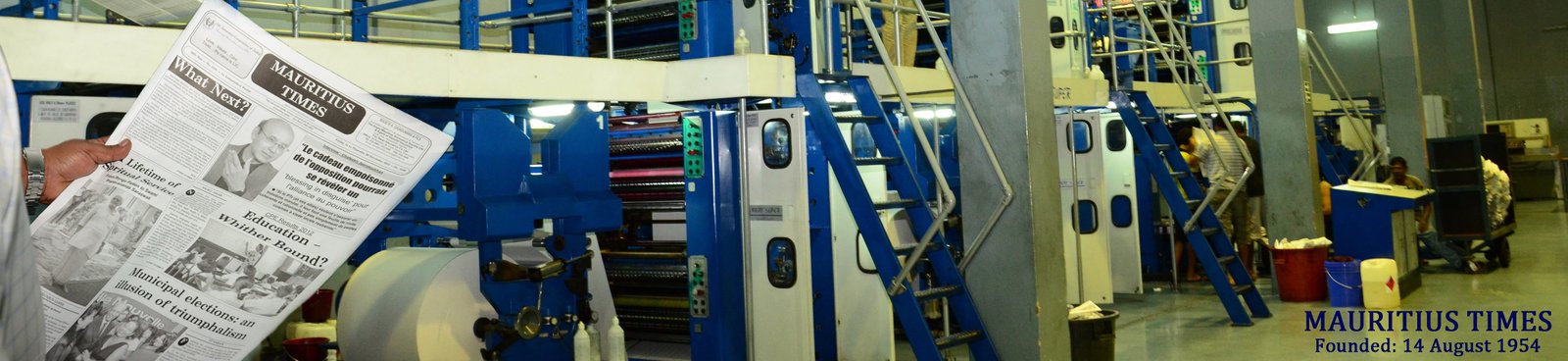
65 years ago Mauritius Times was founded with a resolve to fight for justice and fairness and the advancement of the public good. It has never deviated from this principle no matter how daunting the challenges and how costly the price it has had to pay at different times of our history.
With print journalism struggling to keep afloat due to falling advertising revenues and the wide availability of free sources of information, it is crucially important for the Mauritius Times to survive and prosper. We can only continue doing it with the support of our readers.
The best way you can support our efforts is to take a subscription or by making a recurring donation through a Standing Order to our non-profit Foundation.
Thank you.


