The Mauritian Paradox: How We Sacrifice Our Cosmopolitan Soul and Break Our Global Momentum
Opinion
By Samad Ramoly
Consuming our news and entertainment primarily through TF1 and Canal+ is not just a simple choice of leisure. It is an invisible filter that shapes our worldview. Although our administrative and educational systems are English-speaking, our mental software remains deeply wired to Paris. This cultural dependence creates a systemic and widespread impact across all of Mauritian society:

* A public debate shaped by Paris:We analyse geopolitics and societal issues through the French editorial prism, adopting their controversies and style of verbal confrontation at the expense of local pragmatism.
* The academic cognitive gap:Our youth study and sit for their Cambridge exams in English, but they gather information and dream almost entirely in French. This disconnect breeds an inhibition toward researching, finding entertainment, and expressing themselves spontaneously in English.
* Limited geographical aspirations: The French lifestyle dictated by our screens directs our immigration, education, and tourism plans primarily toward France, unconsciously closing us off to the massive opportunities in English-speaking, African, or Asian hubs.
* The legal software conflict:Caught between a Napoleonic Civil Code and English Common Law, our Francophile mindset constantly clashes with institutions and laws drafted in English, complicating the citizens’ relationship with the judicial system.
* Globalisation by proxy:By neglecting the direct information ecosystem of English — the raw language of tech, finance, and AI algorithms — we receive global innovations that are already translated, filtered, and interpreted by France.
By staying in the comfort of the “Gallic bubble,” Mauritius excels within its region but imposes a glass ceiling on itself when facing the raw speed of the English-speaking “global village.” Ironically, my first publication, released over 25 years ago, was titled The Mauritian Paradox. Alongside my warnings about our widening disconnect from the dollar — the world’s dominant currency — I have consistently sounded the alarm about the adverse consequences of our growing estrangement from the world’s primary language. While we do observe increased English immersion among younger generations thanks to the Internet, it is clear that our political choices remain under the grip of toxic influences.
This is not about nostalgia for a colonial language, nor is it an infatuation with God Save the King or the biting and multicultural wit of Trevor Noah.
It is about instinctively protecting ourselves against insularity, sharpening our intellect, and collectively celebrating the world in all its diversity — without ever losing our soul. Today, social media algorithms and shrinking attention spans control how we think, leaving us vulnerable to hidden and harmful forces of all shades.
Mauritius Times ePaper Friday 31 July 2026
An Appeal
Dear Reader
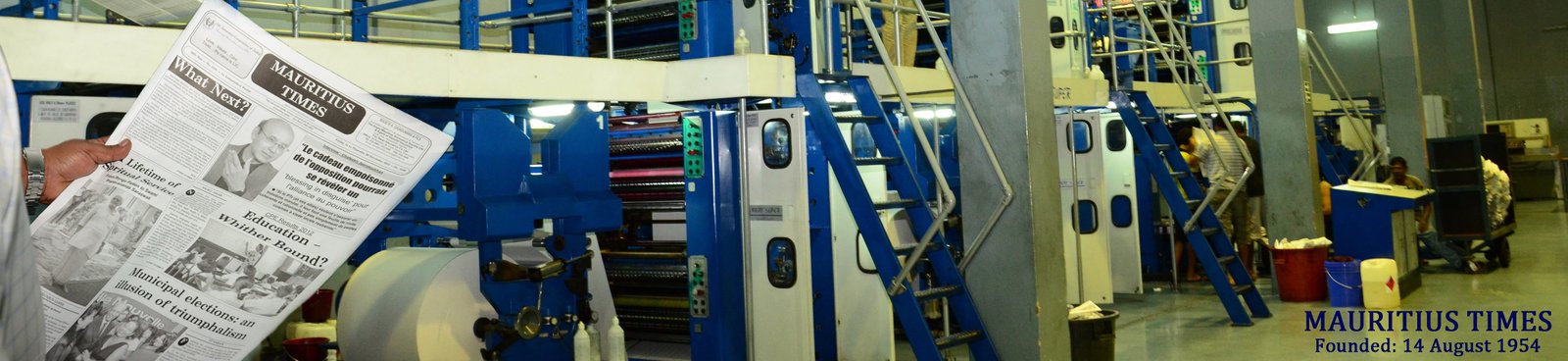
65 years ago Mauritius Times was founded with a resolve to fight for justice and fairness and the advancement of the public good. It has never deviated from this principle no matter how daunting the challenges and how costly the price it has had to pay at different times of our history.
With print journalism struggling to keep afloat due to falling advertising revenues and the wide availability of free sources of information, it is crucially important for the Mauritius Times to survive and prosper. We can only continue doing it with the support of our readers.
The best way you can support our efforts is to take a subscription or by making a recurring donation through a Standing Order to our non-profit Foundation.
Thank you.


