Beekrumsing Ramlallah: A Legacy of Activism and Vision
Honouring a Pioneer
By Nandini Bhautoo
On Tuesday 2 September 2025, the Council Room of the Municipality of Port Louis filled with voices, memories, and tributes for Beekrumsing Ramlallah, whose birth anniversary was commemorated with a symposium organised by the ‘Observatoire de la Démocratie’, founded by veteran trade unionist Jack Bizlall along with Alain Laridon, former trade unionist and politician.
Beekrumsing Ramlallah is remembered as one of the most formidable figures of twentieth-century Mauritius – a teacher, journalist, activist, and cultural pioneer. His political courage, social struggles, and intellectual vision helped shape a society determined to break free from the stranglehold of colonial ideology.
A Voice Against the Establishment
In his address, Jack Bizlall drew parallels between Beekrumsing Ramlallah’s defiance of the establishment and the challenges of today’s shifting geopolitical landscape. He described him as “un tribun” of the Mauritian people – a public orator whose words carried the weight of conviction.
The three other speakers echoed this sentiment. Alain Laridon, long involved in political activism, shared vivid personal anecdotes. Former Vice President Raouf Bundhun, with decades of political life behind him, spoke of a companion-in-struggle and a loyal friend. Their testimonies reminded younger listeners that colonial ideology was not abstract; it was lived reality. It meant control of the press, manipulation of public discourse, and the systematic vilification of anyone who dared to imagine a freer Mauritius.
Among the harshest voices of that colonial era was Noel Marrier Dunienville (NMU), who devoted his career to mocking independence leaders. His infamous slogan “Envelopes nou pas oulé” sought to ridicule the independence movement. But as the speakers recalled, his poison extended further, targeting the young intellectuals who had clawed their way out of deprivation and marginalisation to claim a place in national debate.
It was in this climate of ridicule and repression that Beekrumsing Ramlallah stood his ground, alongside men of conviction — some, like Renganaden Seeneevassen, deeply engaged in politics, and others, such as Kher Jagatsingh, Doojendranath Napal, Somduth Bhuckory, Peter Ibbotson, Jean Georges Prosper, and Hossenjee Edoo, who championed justice and a more equitable society — together with many others from his generation of social activists, writers, and journalists. Together they fought back, through the newspaper that became their weapon: the Mauritius Times.
From Bookshop to Newspaper
The seed for the Times was planted at Nalanda, the bookshop Beekrumsing Ramlallah had founded on Rue Bourbon in Port Louis. More than a shop, Nalanda was a sanctuary for minds hungry for ideas. Its shelves carried books and magazines from India, offering Mauritians access to intellectual currents deliberately kept beyond their reach.
Here, Beekrumsing Ramlallah and his circle realised that changing society required more than protest: it required nurturing minds. From Plato’s dictum that the destiny of a nation depends on how it educates its people, to Francis Bacon’s reminder that knowledge is power, to the Mahābhārata’s chain linking knowledge to happiness:Knowledge gives humility, from humility comes worthiness… from worthiness comes wealth, from wealth comes dharma, and from dharma comes happiness.”– they found inspiration for a project rooted in intellectual awakening.
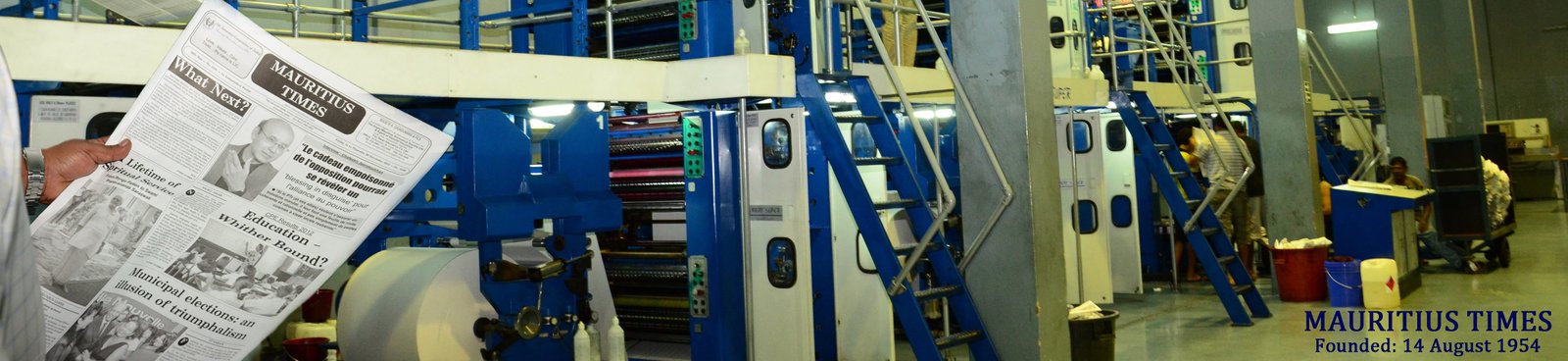
The bookshop gave birth to the newspaper. But to launch the Mauritius Times in 1954, Beekrumsing Ramlallah had to resign from his teaching post. As founder and editor-in-chief, he led battles on multiple fronts – including a successful fight against the Newspapers and Periodicals Amendment Bill, which threatened to silence small independent media with crippling levies. Under his leadership, the Times transformed Mauritian journalism. As former editor-in-chief of l’express and historian Yvan Martial has noted, it shifted the model from passive reporting to opinion-driven debate, opening a space where ideas could directly confront power.
Saving Memory, Saving Identity
Beekrumsing Ramlallah’s vision extended beyond the battles of the day. He recognised that a nation without memory is a nation without future. Among his greatest achievements was the rehabilitation of the Aapravasi Ghat and the preservation of the indenture archives.
When he began, Ghat was a neglected ruin, and the immigration records lay abandoned in deplorable conditions. National institutions showed little interest; the archives, including photographs of Indian indentured labourers, were dismissed as having no patrimonial value.
In the forthcoming book on Beekrumsing Ramlallah, Yvan Martial has revealed that national institutions of the time – most notably the National Archives under Dr Auguste Toussaint – had refused to preserve the indenture records, dismissing them as devoid of patrimonial interest. This is echoed by Sada Reddi in his bibliography of Sir Veerasamy Ringadoo. Thanks to Beekrumsing Ramlallah’s intervention, these documents were transferred to the Mahatma Gandhi Institute, where they are today recognised as part of our collective heritage.
The Immigrant Depot/Coolie Ghat itself was rescued from oblivion. As Martial vividly put it, one would need a statue of Ramlallah, “sleeves rolled up, armed with a pickaxe or sickle, clearing that infinitely sacred soil of the filth tolerated for 135 years of political neglect,” to capture the scale of his achievement. Today, the site stands as the Beekrumsing Ramlallah Interpretation Centre, a landmark of Mauritian identity.
A Legacy of Selfless Politics
Taken together, the tributes painted a portrait of a man who was always ahead of his time. Beekrumsing Ramlallah saw the need to build institutions before society realised its dependence on them. He fought battles not for personal gain but for collective dignity. He nurtured minds, defended free expression, preserved memory, and envisioned a Mauritius in which every citizen could claim ownership of the nation’s destiny.
In celebrating him today, we are reminded that the fate of a society is shaped not only by its leaders and policies, but by those who nourish the life of the mind. Beekrumsing Ramlallah was one such figure — a man who turned ideas into action, and whose legacy remains written into the very fabric of modern Mauritius.
Mauritius Times ePaper Friday 5 September 2025
An Appeal
Dear Reader
65 years ago Mauritius Times was founded with a resolve to fight for justice and fairness and the advancement of the public good. It has never deviated from this principle no matter how daunting the challenges and how costly the price it has had to pay at different times of our history.
With print journalism struggling to keep afloat due to falling advertising revenues and the wide availability of free sources of information, it is crucially important for the Mauritius Times to survive and prosper. We can only continue doing it with the support of our readers.
The best way you can support our efforts is to take a subscription or by making a recurring donation through a Standing Order to our non-profit Foundation.
Thank you.


